eTwinning is an initiative by the European Commision and their eLearning program. I am well familiar with the eTwinning platform, where you for free may communicate, cooperate and develop projects together with one or more schools, within the EU, once your project is accepted by your and their National Support Service, NSS. Today, there are approximately 170 000 members speaking 25 different languages working with more than 5 000 projetcs. I would also like to promote their Proffessional Development Workshops and Teacher forums where you for example may discuss ICT issues and teaching practise.
I have used eTwinning in a couple of projects, among others one with a school in Netherlands. I teach English and Swedish to upper secondary students. However, eTwinning could be used for other age groups in subjects as diverse as music and religion. Below, I will share my experience and give some advice.
To begin with, you become a member, then the most challenging part is to find a partner, a teacher in another school with common and similar goals. An on-line partnerfinding database is available where you may narrow down your search to a specific age group or language. It could take a few months to find a partner and outline a project. There are readymade kits of projects that you could use if you do not have and idea of your own. The last project I participated in, the Dutch teacher and I both agreed that we wanted to encourage our students to use more English and become aware of the fact that even though their level of English was not too advanced, they could still manage to communicate and solve the assignments successfully using ICT tools. The assignment consisted of a few separate activities using different functions within the eTwinning so called "Twinspace" allotted for you project.
 |
| eTwinning Twinspace |
The space is userfriendly and easy to administer. It needs to be pointed out that the other teacher's knowledge of ICT tools was very basic, but she was enthusiastic and when we encountered technical challenges we chatted, Skyped and exchanged messages to sort things out. I introduced her to Skype and she was indeed a fast learner, considering her age, she only had a year to retirement. Obviously, the driving force could encourage you to learn how to use the tools even though you are not a technical digital native. We discovered the versatile platform which among other things offers a staff room and a pupils corner, possibilities to store files, to run a blog and to file photos. We created slide shows and presented each other’s schools, wrote, shared and uploaded protocols. Again, very userfriendly. There is also a calendar function, where you might enter deadlines, school holidays and birthdays for example. Within the platform, you could create wikis and all students as well as teachers have their own account where you create a profile and have a wall where entries could be posted and commented.
Another synergy effect, is that the work is assembled in one space. It is all there to read, reflect upon, evaluate as well as learn from. When it comes to ICT, as this is a beginning of an era, it is indeed valuable, to exchange ideas, evaluate and spread knowledge. Furthermore, cross curricular work may be encouraged when your own work becomes visible to colleagues. Moreover, head masters get an insight into the international and intercultural exchange. This might lead to a focus in your career if your school will invest more time in future projects. Your work may also be evaluated by the NSS and quality labels could be granted. This is of course something that adds to the proffessionalism of your teaching and the school's image if posted on the school's website. You could also participate in different competitions and win prizes. I have for example won a very advanced webcamera which I have used a lot when I Skype.
The different parts of our project were:
1. Introduce yourself.
a. To create a profile.
b. To address a few other students by writing an entry on their walls. Develop this first contact with yet a few posts.
 |
| Chat session |
Comment: A little hesitant at first, but once the student got started, after a while, a few students exchanged email addresses, Skype and Facebook accounts and got to know each other even better using different social media and ways of communicating, This I find excellent, because then they really use English which was a goal itself. The communication became not only asynchronous, but also synchronous as they chatted via Facebook or Skyped. We also tried to chat via the platform. Both in a common chat room, but also in private ones. However, it was difficult to coordinate time and computer availability as the other school did not have a 1-1 solution and we did. Eventually, the students paired up or "twinned up" and the project was running. If I ever do this again, I would suggest groups of four in order for the pairing up being less vulnerable in case somebody quits or is less active. The major advantage was that everybody got the same amount of time during the lessons to express themselves and communicate. This is sometimes a challenge in a group of 30 students, where there are usually a few who talk more. Using this method, the initiatives and exchanges are more evenly distributed and as a teacher you are able to participate by reading their walls. Another advantage was that the "twins" agreed on a topic for their Wikis and they soon found out that they had some interests in common, see below 2.
2. Create a wiki together with a partner in the other school. The pair could then choose a topic to look into and then get started.
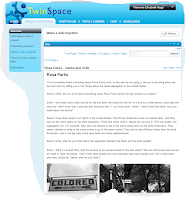 |
| Wiki - Rosa parks by a Dutch and Swedish student |
Comment: Here the "twins" chose a topic, found facts, posed questions, answered and discussed. Then, the students were requested to read the other Wikis and post yet a few questions or comments using the comment function. We had some technical problems with uploading images, because the site had a limit and if a student started html coding a wiki, it was not possible for the "twin" to switch to another mode. We tried to sort it out with the support, but it was probably a bug in the system. However, it was solved during a Skype session by simply restarting the wiki that had this particular problem. It is advisable that the students write their entries in a separate document and then copy and paste their entries. An advantage considering interculture was that they chose topics and issues they took an interest in and exchanged thoughts and found out more step-by-step. The Wikis were very diverse, because the group I taught were from different programs such as Business and administration; Hair dressers; Stylists, Social Science and Child and recreation. Again, a major advantage with this method is that each and every one may work in depth within their field of interest at the same time. A Wiki covered Rosa Park and the Civil Rights Movement while another covered manga, and yet another teenagers' alcohol intake and alcohol culture.
3. News item. Discuss current issues in a Forum. Starting threads and commenting upon other entries.
Comment: This was the most advanced part of the assignment, in relation to their level of English, where they used English that was more advanced than the Wikis. It was very interesting to follow the threads, read their entries and participate in the development of for example the discussion on death penalty. We used articles in English published on Stockholm news in English, for example:
“ 100 years since the last Swedish execution
Culture | 2010-11-24 Today it is exactly 100 years ago since the last execution was conducted in Sweden. It was the first, and last, time a guillotine was used as a form of execution. Johan Alfred Andersson Ander was executed after being convicted of murder. He had stolen more than 5000 Swedish kronor (a lot of money in these days) from a woman who he killed during the robbery. Previous executions had been performed by manual beheading but now the imported guillotine from France was to be used for the first time. Bizarrely but true, it is easy to imagine the excitement among the audience. Mr Andersson Anders was denied saying some last words and the whole spectacle is reported to have been over very quickly. Eleven years later, in 1921, the death penalty was abolished in Sweden, so the imported guillotine was only used once, and can now be seen at the Nordic museum in Stockholm. You can see it here."
Tommie Ullman tommie.ullman@stockholmnews.com
 |
| Forum - discussing current news |
First, I started a new thread where I uploaded the article and then a few questions were added in order to begin the discussion like for example: “Bangladesh, Botswana, Egypten, Iran, Irak, Japan, Jemen, Kina, Libyen, Malaysia, Nordkorea, Saudiarabien, Singapore, Sudan, Syrien, Thailand, USA och Vietnam, these countries still have the death penalty and executed people last year. What are your opinions on death penalty? Is there a crime that "deserves" it? Discuss and argue for and against. Give examples to support what you claim, please.”
The software allowed several categories, subcategories, threads and posts. You could reply with or without quotes. I found it very easy to use and easy to survey, because the layout is very userfriendly. I am however looking for similar well functioning forum sites outside eTwinning in case you do not have a partner school and prefer to do this within the class you are teaching or within the school or in between two Swedish Schools. That is why I am currently looking into Schoolsoft’s possibilities. Again, using a tool like this gives each student the same amount of time and space to express themselves and as a teacher you have a lot of material as a basis for your grading. I had four students with Asperger Syndrom and they really bloomed in this working environment.
4. Evaluation in a shared Google survey.
Comment: Very easy to administer and get an overview in order to reflect on what might be improved another time. For example being four instead of two when creating the Wiki. Apart from that, the students were very pleased with their work and the design of the assignment. Where I used to work while I did this project, the school had a 1-1 solution and the partner school did not. Therefore, it was difficult for example to have a live chat session because they did not have access to computers and Internet and it was difficult to coordinate times as well. Some students used Skype in their spare time and I find it very rewarding that some students used English outside school hours. It was furthermore, very rewarding to learn a lot about the different tools as the project developed and to encourage one another. We learnt a lot about running a longterm project and unfortunately the Dutch teacher retired the year after the project so therefore we never got the chance to further develop our project, but we still Skype now and then.
Hopefully, you have been encouraged to give eTwinning a try, if this source is new to you. If you have any questions, get in touch and we may exchange some ideas.


